

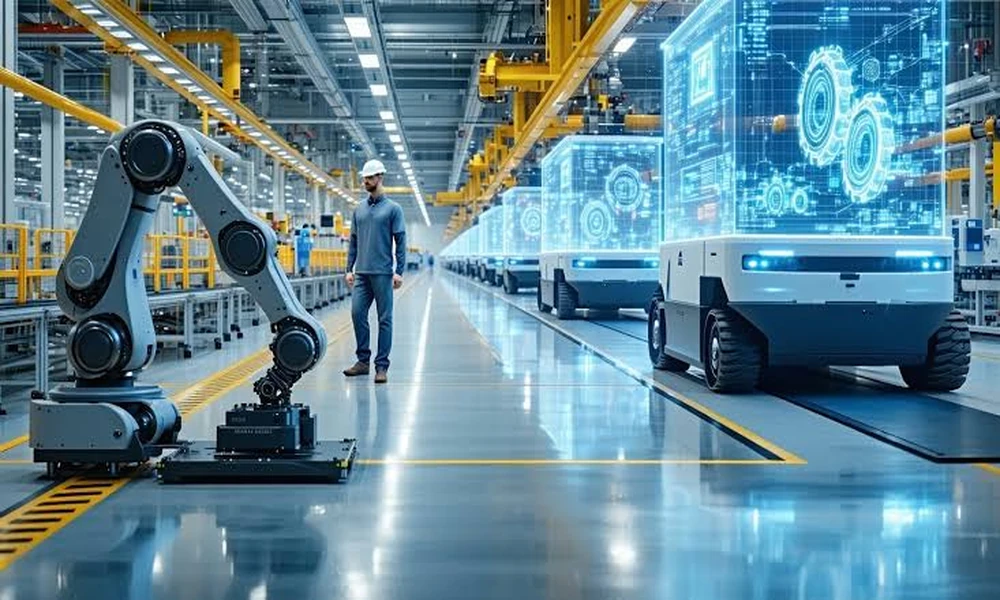
Manufacturing has always relied on automation where repetition and production volume justified the investment. What has changed is the environment in which many factories now operate. Product ranges are broader, customers expect more variants, and production schedules can change much faster than they did in traditional mass manufacturing. As a result, manufacturers increasingly need automation that can adapt rather than equipment designed around one task for its entire working life.
This shift affects the way robotic systems are selected. Payload, reach and speed remain important, but companies are paying more attention to the tools, software and peripherals that determine what a robot can actually do on the production floor.
A robot arm is only one part of an automated process
A robot can move accurately between programmed positions, but movement alone does not manufacture, pack or inspect anything. The robot needs a way to interact with the product, which may mean gripping a component, applying controlled force, tightening a screw or handling a box. The equipment mounted on the robot therefore has a major influence on the usefulness of the complete system.
Suppliers such as Onrobot illustrate how broad this tooling layer has become. Current product categories include electric, vacuum and magnetic grippers as well as force/torque sensors, screwdriving equipment and tools for surface finishing. The important point for a manufacturer is not the number of available tools, however, but whether the selected combination can handle real production variation without excessive re-engineering.
Why shorter production runs change the automation calculation
Dedicated automation performs particularly well when the same product is manufactured for a long period. Engineering costs can then be spread across a large number of units, and there may be little reason to change the cell once it has been optimised. High-mix manufacturing creates a different challenge because the same equipment may need to deal with several product families.
In this environment, changeover time becomes part of the return-on-investment calculation. If every new product requires new fixtures, specialist programming and several hours of downtime, the apparent flexibility of a robot may have limited practical value. Adjustable grippers, reusable mounting systems and software-based parameters can reduce some of that work, although they cannot eliminate the need for proper process engineering.
Software is reducing some traditional barriers
Programming has long been one of the costs associated with robotic automation. Conventional robot programming is still appropriate for many complex applications, but newer systems increasingly allow users to configure common tasks through application-oriented interfaces.
OnRobot’s D:PLOY platform is one example. It currently supports transferring, CNC machine tending, packaging and palletizing applications, with the system designed to reduce the amount of conventional programming needed when setting up those tasks. This type of approach can be particularly relevant to companies that frequently change products because the cost of redeployment may matter as much as the cost of the original installation.
Simplified programming should not be confused with automatic success. Fixtures must still position workpieces correctly, tooling must suit the product, and the complete application needs appropriate safety assessment.
Flexible automation is not automatically the right solution
The fact that robots can be reconfigured does not mean every manual task should be automated. Some processes change too frequently, involve too many exceptions or occur too rarely to justify the investment. In these cases, a skilled employee may remain more efficient than a robotic system that requires constant adjustment.
The strongest candidates for flexible automation are usually processes with a repeatable core but some predictable variation. Machine loading, packaging, part transfer, assembly and certain finishing operations often fall into this category because the basic task remains similar even when product dimensions or production batches change.
Look beyond the first application
A useful way to assess an automation investment is to consider what happens after the first product disappears from the production schedule. If the robot, tooling and software can be adapted to another realistic task, the equipment has a better chance of maintaining high utilisation over its working life.
That does not require a universal robot cell capable of doing everything. In fact, designing for every conceivable future scenario can make a system unnecessarily expensive and complicated. The goal is more practical: choose an architecture flexible enough for the range of changes the factory is genuinely likely to face.
For modern manufacturers, that ability to adapt may become one of the most important differences between automation that works well for a single project and automation that remains valuable for years.